
5G Wireline Access Architecture

 I have looked at Wireless Wireline Convergence (WWC) and Fixed Mobile Convergence (FMC) in many different posts in our blog posts (see related posts at the end). 
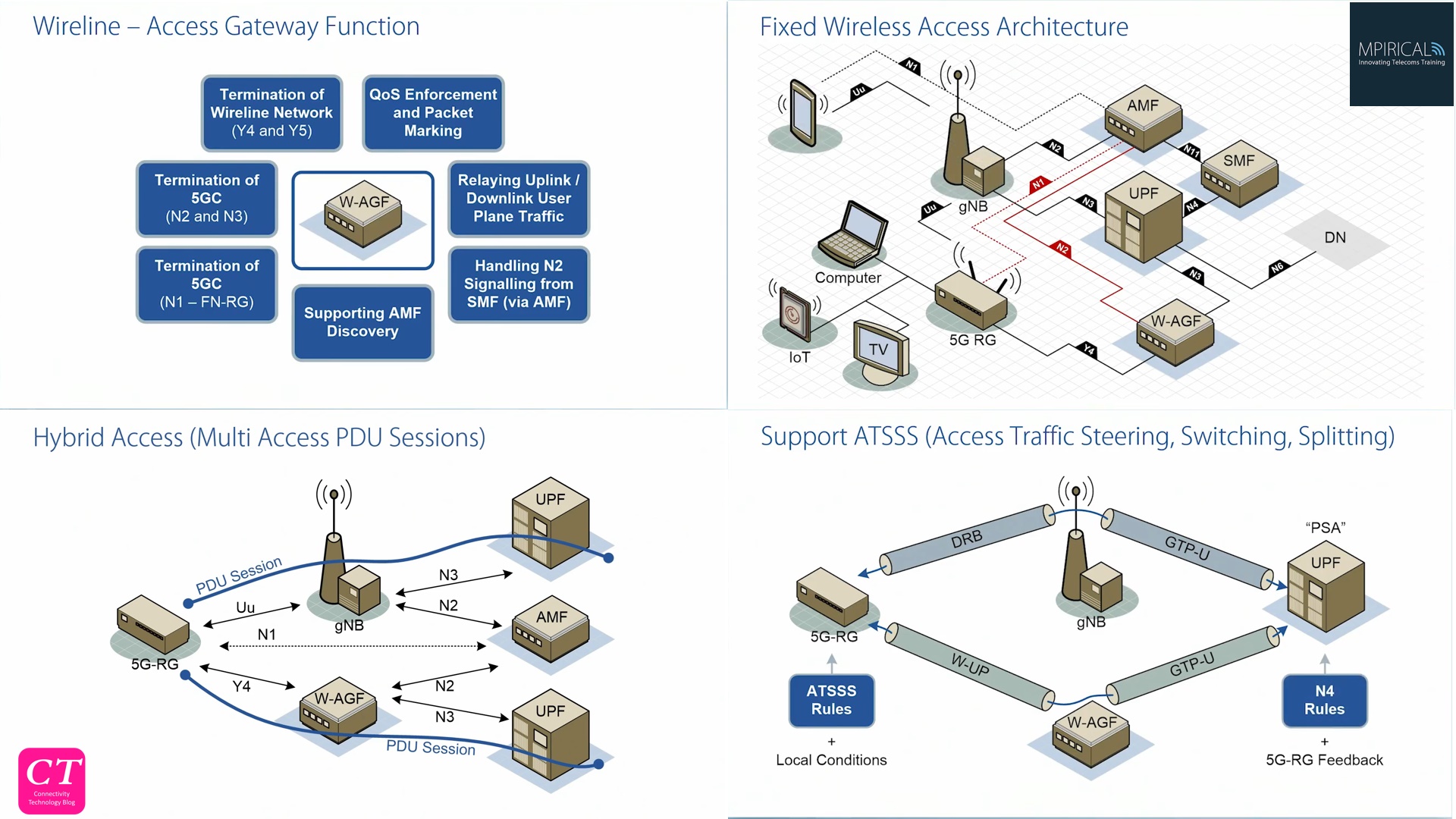

The training company, Mpirical, recently added a short video on 5G Wireline Access and what exactly it will bring us. This video is taken from their 5G Wireline Access course and  explains how connectivity with wireline access networks is supported in 5G networks. The video is embedded below.

With Voice over Wi-Fi gaining prominence and offloading becoming a necessity in many cases as well, WWC is the next logical step that quite a few operators are looking at. The main dependency is having 5G core, so we will have to wait for Standalone 5G to be rolled out before this can be tried with real users and a commercial network. 

Related Posts:

Comments

  1. Actually, you do not need to wait for Standalone 5G Core to move forward with WWC, Tessares "Overlay ATSSS" is offering this functionality right now.
    https://www.tessares.net/papers/

    ReplyDelete

Post a Comment

Popular posts from this blog

Laser Inter-Satellite Links (LISLs) in a Starlink Constellation

When we first talked about Starlink back in 2019 , we saw in the video that the concept involved laser communication to communicate between the satellites. While the initially launched satellites did not have the laser communication mechanism built in, it looks like they are being added to the newer ones.  A report from Fast Company in late 2021 said: One of the next big upgrades in telecom will involve satellites firing lasers at each other—to beam data, not blow stuff up. The upside of replacing traditional radio-frequency communication with lasers, that encode data as pulses of light, can be much like that of deploying fiber-optic cable for terrestrial broadband: much faster speeds and much lower latency. “Laser links in orbit can reduce long-distance latency by as much as 50%, due to higher speed of light in vacuum & shorter path than undersea fiber,” SpaceX founder Elon Musk tweeted in July about the upgrade now beginning for that firm’s Starlink satellite constellation. ...

IEEE 802.11bn Ultra High Reliability (UHR), a.k.a. Wi-Fi 8

Back in 2020 we looked at the introductory post of Wi-Fi 7 which was followed up by a more detailed post in Feb 2022. We are now following on with an introductory post on the next generation Wi-Fi.  A new paper on arXiv explores the journey towards IEEE 802.11bn Ultra High Reliability (UHR), the amendment that will form the basis of Wi-Fi 8. Quoting selected items from the paper  below: After providing an overview of the nearly completed Wi-Fi 7 standard, we present new use cases calling for further Wi-Fi evolution. We also outline current standardization, certification, and spectrum allocation activities, sharing updates from the newly formed UHR Study Group. We then introduce the disruptive new features envisioned for Wi-Fi 8 and discuss the associated research challenges. Among those, we focus on access point coordination and demonstrate that it could build upon 802.11be multi-link operation to make Ultra High Reliability a reality in Wi-Fi 8. The IEEE 802.11bn UHR: Whose ...

How Do Apple AirTags Work?

Apple AirTags have steadily gained popularity in the smart tag market. A recent report highlighted that 69% of smart tag buyers in late 2024 chose an Apple AirTag. This marks a significant rise from 45% in early 2022. In contrast, Tile, the category pioneer now owned by Life360, has seen its market share fall to 11% from 17% during the same period. Samsung's Galaxy SmartTags now hold second place. Interestingly, the technology behind AirTags resembles concepts like Opportunity Driven Multiple Access (ODMA) or Multihop Cellular Networks (MCNs), which I have previously explored . A similar approach has also been discussed regarding Bluetooth-based Ad-Hoc networks . How Do They Work? AirTags primarily use Bluetooth Low Energy (BLE) to communicate with nearby Apple devices that are part of the Find My network. This vast network consists of millions of Apple devices, including iPhones, iPads, and Macs, which can detect AirTags and securely relay their location back to the owner. Addit...